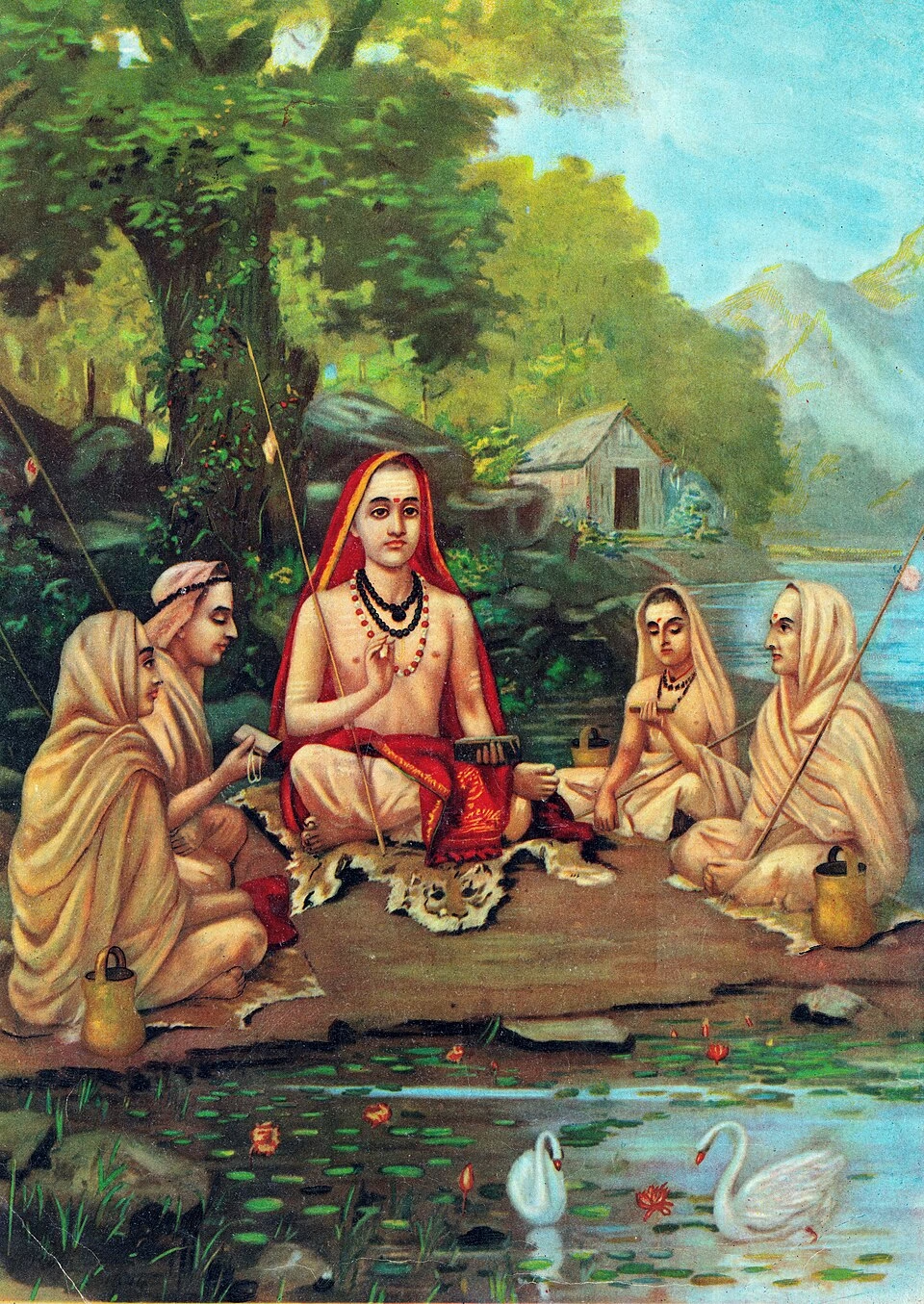
Adi Shankaracharya (c. 788–820 CE) was a preeminent Indian philosopher, theologian, and monk who consolidated the doctrine of Advaita Vedanta. Often revered as an incarnation of Lord Shiva, he is credited with reviving Hinduism during a period of significant sectarian division and external challenge. Image source: Wikipedia/By Raja Ravi Varma – Google Arts & Culture
Read these first:-
- Religion 101: Sadhguru and Zakir Naik Compared
- History 101: The Legacy of Swami Vivekananda, His Teachings and Relevance in the Modern World
- Health 101: Powerful Kriya Yoga: A Quick Introduction
- Religion 101: Understanding the 10 Types of Sins in Hindu Philosophy
Who is Adi Shankaracharya?
Adi Shankaracharya, a pivotal figure in the landscape of Hindu philosophy, was born in the early 8th century in Kaladi, a village in present-day Kerala, India. His life spanned a transformative period in Indian history, marked by cultural and spiritual revival following centuries of foreign invasions. Shankaracharya is renowned for his profound contributions to Advaita Vedanta, a non-dualistic school of thought that emphasizes the unity of the soul (Atman) and the ultimate reality (Brahman).
From a young age, Shankaracharya demonstrated remarkable intellectual abilities and spiritual inclination. Orphaned at a tender age, he renounced worldly attachments and embarked on a quest for enlightenment. His journey led him to various sacred places across India, where he engaged in deep philosophical discussions with learned scholars and established his authority as a philosopher and theologian.
Shankaracharya’s teachings centered around the concept of Maya, or illusion, and the realization that the material world is transient, while the ultimate truth is unchanging. Through his discourses and writings, he wrote several commentaries on the Upanishads, the Bhagavad Gita, and the Brahma Sutras, elucidating complex philosophical ideas into accessible formats. His seminal works include the renowned ‘Vivekachudamani’ and ‘Bhajagovindam’, which remain influential in philosophical and spiritual circles.
A key aspect of Shankaracharya’s legacy lies in his establishment of the four major mathas (monastic orders) across India, which played a vital role in propagating Advaita Vedanta and ensuring the continuity of his teachings. He traversed the subcontinent, not only imparting philosophical wisdom but also reforming Hindu practices, thus fostering unity among various sects and schools of thought. Through his tireless efforts, Adi Shankaracharya emerged as a beacon of Hindu philosophy, whose insights continue to illuminate spiritual seekers to this day.
The Historical Context of Shankaracharya’s Life
The period during which Adi Shankaracharya lived, approximately in the early 8th century CE, was marked by significant socio-political and religious transformations in India. This was a time when India was witnessing the influence of various philosophical schools, particularly Buddhism, which had gained prominence. The arrival of Buddhism had a considerable effect on the traditional spiritual practices of the region, often challenging and reshaping the existing belief systems.
During Shankaracharya’s time, Hinduism was fragmented, characterized by diverse traditions and practices that somewhat deviated from the core philosophies of the Vedas. The Buddhist ideologies emphasized concepts such as impermanence and non-attachment, which often conflicted with Hindu beliefs. In response to this complexity, Shankaracharya emerged as a pivotal figure whose mission was to revive and clarify the teachings of the Vedas, presenting a philosophical framework that reconciled various domains of thought within Hinduism.
Moreover, Shankaracharya faced the challenge of addressing regional sectarian disputes that further complicated the unity within Hinduism. His encounters with various schools of thought, including the teachings of the Charvakas and the dualistic interpretations of various ascetic practices, provided fertile ground for his philosophical inquiries. His efforts culminated in a synthesis that not only reaffirmed the authority of the Vedas but also integrated diverse elements of contemporary spiritual thought.
Through his commentaries on fundamental texts, such as the Upanishads and the Bhagavad Gita, Shankaracharya laid the groundwork for Advaita Vedanta, promoting a non-dualistic understanding of reality that emphasized the unity of the individual soul with the ultimate reality, Brahman. His teachings played a crucial role in revitalizing the spiritual landscape of India, ultimately leading to a renaissance of Hindu philosophical thought. This historical backdrop is vital to understanding the significance of Shankaracharya’s contributions and the lasting impact he has had on Hindu philosophy.
Please accept YouTube cookies to play this video. By accepting you will be accessing content from YouTube, a service provided by an external third party.
If you accept this notice, your choice will be saved and the page will refresh.
.
Shankaracharya’s Philosophical Teachings
Adi Shankaracharya, a pivotal figure in Hindu philosophy, is best known for his establishment of Advaita Vedanta, a non-dualistic school of thought. At the core of his philosophy lies the concept of Brahman, regarded as the ultimate reality which transcends the material universe. According to Shankaracharya, Brahman is formless, infinite, and eternal, existing beyond all dualities of existence. This essence acts as the foundation of understanding in his teachings, proposing that everything in the cosmos is an expression of this singular reality.
A central aspect of Advaita Vedanta is the relationship between Brahman and Atman, which refers to the individual soul or self. Shankaracharya posited that Atman is not separate from Brahman; rather, it is a manifestation of this ultimate reality. The realization of one’s true self as Atman—pure consciousness—serves as the path to understanding the illusory nature of the world. This leads us to the concept of Maya, or illusion, which Shankaracharya explains as the veiling of the ultimate truth. He emphasizes that the perceived dualities of life, such as pleasure and pain, self and other, are merely constructs of Maya; thus, they distract individuals from recognizing their intrinsic unity with Brahman.
In his teachings, liberation, or Moksha, is seen as the primary goal of life. It is achieved through knowledge (Jnana) and the realization of the non-dual nature of existence. Shankaracharya advocated for a disciplined spiritual practice, encompassing self-inquiry and meditation, as essential tools for dismantling the misconceptions perpetuated by Maya. By attaining Moksha, an individual transcends the cycle of birth and death, experiencing eternal bliss and complete identity with Brahman. Shankaracharya’s philosophical contributions continue to inspire seekers and scholars alike, guiding them toward profound realizations about the nature of reality and self.
The Importance of Adi Shankaracharya in Hinduism
Adi Shankaracharya, a pivotal figure in the landscape of Hindu philosophy, played a crucial role in shaping the intellectual and spiritual framework of Hinduism. Born in the early 8th century, Shankaracharya established the Shankara Sampradaya, a monastic tradition that emphasizes Advaita Vedanta—the philosophy of non-dualism. His teachings advocate that the ultimate reality, Brahman, is the only truth, while the material world is an illusion (Maya). This fundamental perspective has profoundly influenced Hindu thought and practice for centuries.
One of Shankaracharya’s significant contributions was his emphasis on coherence and unification within a diverse religious landscape. At a time when various sects and philosophical schools emerged, his efforts to synthesize disparate teachings helped forge a more unified discourse within Hinduism. By engaging with other philosophies, Shankaracharya clarified the essence of Vedanta and provided a logical foundation for spiritual seekers. His commentaries on the Upanishads and the Bhagavad Gita remain central texts in Hindu philosophy, offering profound insights that continue to resonate with contemporary practitioners.
Shankaracharya’s influence extends beyond scripture; he was instrumental in establishing monastic centers across India, known as mathas, which continue to serve as cultural and spiritual hubs. These institutions facilitate the transmission of his teachings to future generations and nurture scholarship in various religious disciplines. Additionally, his thoughts have inspired many later philosophers and theologians, who have drawn upon his ideas to develop their interpretations of Vedanta.
In essence, Adi Shankaracharya’s teachings and philosophies are cornerstones of Hinduism, assisting believers in understanding complex spiritual concepts while encouraging exploration and practice. His legacy is not merely historical; it continues to shape the spiritual lives of countless Hindus today, ensuring that his insights remain relevant in an ever-evolving religious landscape.
The Four Mathas Founded by Shankaracharya
Adi Shankaracharya, an influential philosopher and theologian in Hindu belief, is revered for establishing four major monastic centers known as Mathas. These institutions not only served as sites for spiritual learning but also played a pivotal role in the propagation of his Advaita Vedanta philosophy. The four Mathas—Govardhan Matha in Puri, Sharada Peeth in Sringeri, Kanchi Kamakoti Peeth in Kanchipuram, and Dwaraka Sharada Peeth in Dwaraka—each hold unique significance and contribute profoundly to the contemporary understanding of Hinduism.
Govardhan Matha, located in Puri, Odisha, emphasizes the worship of Lord Jagannath and the teachings of Shankaracharya. This Matha stands as a beacon for pilgrims and scholars alike, facilitating discussions on philosophical doctrines while maintaining ancient traditions. Its role in hosting rituals and festivals draws significant attention, thereby promoting the essence of Advaita philosophy through community involvement.
Sharada Peeth in Sringeri, Karnataka, is regarded as the first Matha established by Shankaracharya. It is notable for its educational institutions and scriptural studies, which attract students and spiritual seekers from across the globe. The Peeth continues to be a crucial hub for Vedic education, ensuring that Shankaracharya’s teachings remain relevant in modern contexts. Through various initiatives, it seeks to blend ancient wisdom with contemporary issues, thereby enriching adherence to Hindu philosophies.
Kanchi Kamakoti Peeth in Kanchipuram focuses on the worship of Goddess Kamakshi and promotes a holistic understanding of spirituality through its teachings. It plays an essential role in spiritual discourse and social reform activities, reaffirming the importance of Shankaracharya’s principles in addressing societal challenges.
Lastly, Dwaraka Sharada Peeth in Dwaraka serves as a vital center for the preservation of philosophical and cultural heritage. Each of these Mathas continues to flourish under the guidance of their respective heads, who are dedicated to upholding Shankaracharya’s legacy, thereby pioneering efforts to promote wisdom and spirituality in today’s world.
Please accept YouTube cookies to play this video. By accepting you will be accessing content from YouTube, a service provided by an external third party.
If you accept this notice, your choice will be saved and the page will refresh.
.
Shankaracharya’s Writings and Commentaries
Adi Shankaracharya, a pivotal figure in Hindu philosophy, is renowned for his profound writings and commentaries that have significantly shaped the understanding of Vedanta. His comprehensive interpretations of critical texts such as the Brahma Sutras, the Upanishads, and the Bhagavad Gita serve as essential tools for spiritual study and practice. Each of these works reflects Shankaracharya’s exceptional clarity of thought and depth of insight, which have made them essential for anyone engaged in the study of Advaita Vedanta.
One of Shankaracharya’s most notable contributions is his commentary on the Brahma Sutras, which lays the doctrinal foundation for Vedanta. His exposition elucidates the complex philosophical concepts contained within the Sutras, presenting them in a coherent and accessible manner. This commentary not only serves to clarify the intent of the original text but also engages with various viewpoints, establishing the non-dualistic nature of reality articulated in the Sutras. His rigorous analysis provides readers with a comprehensive understanding that remains relevant to contemporary scholars and practitioners alike.
In addition to the Brahma Sutras, Shankaracharya’s commentaries on the Upanishads are critical in comprehending the spiritual insights embedded within these ancient texts. Each Upanishadic text is approached with meticulous attention to detail, revealing the philosophical underpinnings of consciousness and the ultimate nature of reality. His interpretations encourage seekers to delve into the deeper meanings of existence, guiding them towards self-realization and liberation.
Furthermore, Shankaracharya’s commentary on the Bhagavad Gita stands out for its practical application of Vedantic principles in everyday life. The Gita serves not merely as a spiritual guide but as a manual for ethical living and self-inquiry. Through his distinctive reading, Shankaracharya harmonizes action, devotion, and knowledge, thus making the teachings of the Gita accessible to a diverse audience.
Through these foundational texts, Shankaracharya has left an indelible mark on the landscape of Hindu philosophy, ensuring that the principles of Vedanta continue to inspire and enlighten spiritual seekers across generations.
Shankaracharya’s Influence on Later Thinkers
Adi Shankaracharya’s profound teachings set a foundation for subsequent Indian philosophers, whose works often reflected or reacted to his non-dualistic perspective. Notably, his ideas impacted the evolution of two major schools of thought in Hindu philosophy: the Vishishtadvaita of Ramanuja and the Dvaita of Madhva. Each of these thinkers engaged with Shankaracharya’s concepts, leading to a rich tapestry of philosophical discourse.
Ramanuja, who arrived on the philosophical scene in the 11th century, was a significant figure known for his Vishishtadvaita or qualified non-dualism. He presented a different interpretation of the concepts of Brahman and the individual soul (Atman). While Shankaracharya emphasized the oneness of the absolute reality, Ramanuja argued for a personal God, Vishnu, who is distinct yet inseparably connected to individual souls. This theological divergence highlighted a growing diversity within Hinduism, allowing for devotional practices (bhakti) to flourish, which contrasted with Shankaracharya’s more ascetic approach.
In the subsequent century, Madhva articulated yet another branch of philosophy, known as Dvaita, or dualism. His teachings posited a clear distinction between God and individual souls, thus opposing Shankaracharya’s non-dualism. Madhva emphasized the eternal difference between the divine and the devotee, which provided a framework for a vibrant devotional movement. His criticism of Shankaracharya’s views was not merely a refutation but a pivotal dialogue that shaped various schools of theistic thought in Hinduism.
Overall, the legacy of Adi Shankaracharya is evident in the discussions and disagreements of later thinkers. His influence was instrumental in shaping the philosophical landscape of India, ensuring that Hinduism evolved into a diverse tradition that accommodates a myriad of perspectives on spirituality, metaphysics, and the nature of the divine.
Please accept YouTube cookies to play this video. By accepting you will be accessing content from YouTube, a service provided by an external third party.
If you accept this notice, your choice will be saved and the page will refresh.
.
Modern Relevance of Shankaracharya’s Teachings
Adi Shankaracharya, a formidable figure in the landscape of Hindu philosophy, continues to hold significant relevance in contemporary spiritual practices and discussions. His core teachings, particularly the concept of Advaita Vedanta, emphasize the non-dual nature of reality and the unity of the individual soul (Atman) with the universal consciousness (Brahman). These principles resonate strongly in today’s fast-paced, technology-driven world, where individuals often seek deeper meaning and connection beyond material existence.
In modern spiritual discourse, Shankaracharya’s emphasis on self-inquiry and introspection offers invaluable tools for personal development. His teachings encourage practitioners to question their assumptions and beliefs, prompting a journey toward self-realization. This approach aligns well with contemporary practices such as mindfulness and meditation, which advocate for present-moment awareness and self-reflection. Individuals navigating life’s complexities find solace and guidance in Shankaracharya’s teachings, as they provide a framework to understand one’s place in the cosmos and promote inner peace.
Furthermore, the application of Shankaracharya’s philosophy extends beyond personal growth into broader philosophical dialogues around the globe. His ideas have found resonance in various modern philosophical discussions, particularly regarding the nature of consciousness and existence. Scholars and philosophers from diverse backgrounds often engage with Advaita Vedanta concepts, drawing parallels with Western philosophies and exploring intersections that promote greater understanding across cultural and spiritual divides.
Ultimately, the timeless insights of Adi Shankaracharya serve as a beacon for those on a quest for spiritual enlightenment and intellectual pursuit. They not only enrich individual lives but also facilitate deeper connections among different philosophical traditions in an increasingly interconnected world. In conclusion, the teachings of Shankaracharya remain profoundly relevant, addressing the spiritual needs of contemporary society while contributing to global philosophical discourse.
Final Say
Adi Shankaracharya remains an influential figure in the landscape of Hindu philosophy. His teachings, steeped in the principles of Advaita Vedanta, emphasized the oneness of the individual soul (Atman) with the ultimate reality (Brahman). Through his commentaries on the Upanishads and the Bhagavad Gita, Shankaracharya brought clarity and depth to complex spiritual concepts, making them accessible to a wider audience. This democratization of spiritual knowledge played a significant role in shaping the philosophical discourse within Hinduism.
The legacy of Shankaracharya extends beyond his scholarly contributions; he was also pivotal in establishing monastic orders that have continued to foster spiritual inquiry and discipline throughout the centuries. These institutions have ensured the continuity of his teachings, allowing subsequent generations to engage with and reflect on his profound insights. The presence of these monastic communities serves as a testament to his enduring influence and commitment to spiritual practice.
Moreover, Shankaracharya’s philosophical framework remains relevant in contemporary debates about the nature of reality, the self, and the universe. His teachings resonate with those seeking clarity in an increasingly complex world, offering a lens through which individuals can explore their existence and the interconnectedness of all beings. The core tenet of Advaita Vedanta—that realization of self leads to understanding the larger cosmos—continues to inspire spiritual seekers across various backgrounds.
As we reflect on the life and teachings of Adi Shankaracharya, it is compelling to encourage further exploration of his philosophy. Delving into his works can provide invaluable insights that help navigate the complexities of life, fostering a deeper sense of connection, purpose, and understanding in one’s spiritual journey.