Skip to content

USA

Military 101: The Evolution of Anti-Tank Weapons in World War II

Anti-Tank Bazooka Military Weapon World War 2

The Bazooka, officially known as the M1 rocket launcher, was a groundbreaking American anti-tank weapon introduced in 1942 during World War II, revolutionizing infantry warfare by providing foot soldiers with a portable means to combat armored vehicles. This shoulder-fired, 2.36-inch diameter tube launched fin-stabilized, high-explosive shaped-charge rockets (like the M6) up to 200 yards effectively, penetrating up to 100mm of armor—enough to cripple German Panzers and Japanese tanks. Image source: U.S. Army Signal Corps/Wikimedia

Read More »Military 101: The Evolution of Anti-Tank Weapons in World War II

Technology 101: AWACS – Dynamics Of Electronic Jamming

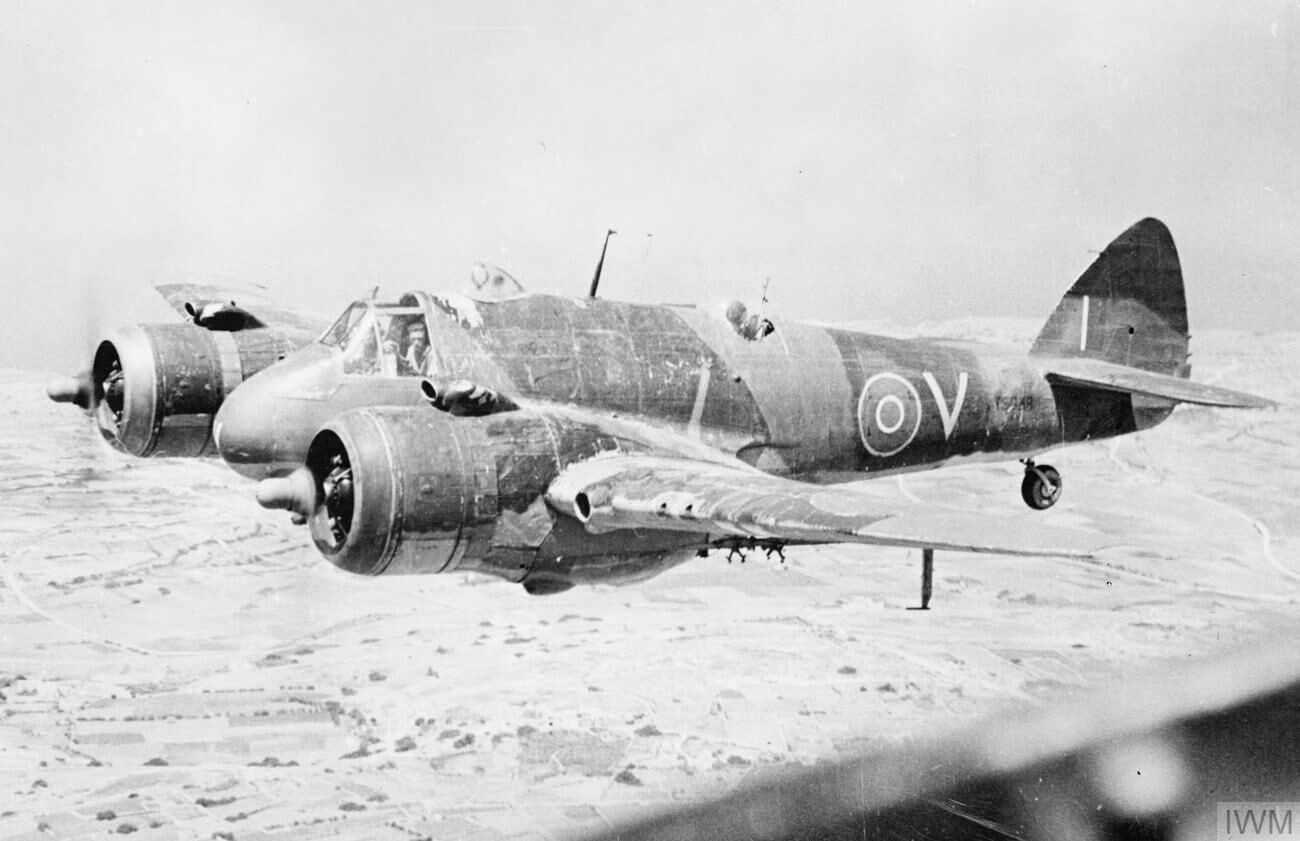
AWACS British Aircraft Plane Bristol Beaufighter Radar Early Warning

During World War II, dedicated AWACS aircraft did not exist, but several nations employed radar-equipped planes for detection. A notable example is the British Bristol Beaufighter, a twin-engine heavy fighter fitted with the Airborne Interception (AI) Mk IV radar. Serving the Royal Air Force (RAF) in night operations, it effectively tracked Luftwaffe bombers during the Blitz, with a radar detection range of about 10 miles. Lacking command-and-control capabilities, it relied on ground stations for coordination. Image source: Royal Air Force / Imperial War Museums

Read More »Technology 101: AWACS – Dynamics Of Electronic Jamming

Military 101: The F/A-18 Hornet: Agile, Lethal And Multi-Role

F/A-18 Hornet Fighter Jet RMAF Aircraft

The F/A-18 Hornet’s design lineage traces back to the Northrop YF-17, a prototype developed for the U.S. Air Force’s Lightweight Fighter (LWF) program. While the YF-17 itself didn’t win the Air Force competition, its design proved highly adaptable to the U.S. Navy’s requirements for a multirole fighter. The Navy’s need for a carrier-based aircraft led to significant modifications, including a strengthened airframe, folding wings, and enhanced avionics, culminating in the F/A-18 Hornet. Image source: By US Air Force – dvidshub.net, Public Domain

Read More »Military 101: The F/A-18 Hornet: Agile, Lethal And Multi-Role

Technology 101: Missions To Moon: A Giant Leap For Mankind

Lunar Moon Mission Astronaut Space

The Apollo program, a monumental achievement by NASA, was the United States’ endeavor to land humans on the Moon. Spanning from 1961 to 1972, it reached its pinnacle with Apollo 11 in July 1969, when Neil Armstrong and Buzz Aldrin became the first humans to walk on the lunar surface. In total, six Apollo missions successfully landed on the Moon, with 12 astronauts exploring its terrain and collecting valuable lunar samples. Image source: Unsplash

Read More »Technology 101: Missions To Moon: A Giant Leap For Mankind