Skip to content

2025

Movie Review 101: Star Wars: Rogue One – Brilliant Side Story of Star Wars

Star Wars Rogue One John William Death Star Darth Vader

‘Rogue One: A Star Wars Story’ is a pivotal standalone film that enriches the Star Wars saga by exploring the rebellion’s mission to steal the Death Star plans. Directed by Gareth Edwards, it introduces compelling characters like Jyn Erso and Cassian Andor, weaving themes of hope, sacrifice, and moral complexities within a gripping narrative. With stunning visuals and a powerful score, the film has received critical acclaim and commercial success, solidifying its place in the Star Wars universe. This post analyzes the film’s storyline, character development, cinematography, and its significant ties to ‘A New Hope’, exploring what makes ‘Rogue One’ a memorable entry in the franchise. Image source: Hollywood Reporter

Read More »Movie Review 101: Star Wars: Rogue One – Brilliant Side Story of Star Wars

Military 101: Bunker Buster Bombs: A Global Perspective

Bunker Buster Bomb Weapon US

The BLU-122 is a 5,000-pound class precision-guided penetrator warhead developed by the United States Air Force as a modern successor to the Vietnam-era BLU-82 “Daisy Cutter” and the earlier GBU-28 bunker buster bomb. It is specifically designed to defeat deeply buried and hardened targets (DBHTs) such as underground command centers, weapons-of-mass-destruction storage sites, and reinforced tunnels that are beyond the reach of the older GBU-28 (also 5,000 lb class) and even the 30,000 lb GBU-57 Massive Ordnance Penetrator (MOP) in certain scenarios requiring lower collateral damage or delivery from tactical aircraft. Image source: US Air Force / Wikipedia

Read More »Military 101: Bunker Buster Bombs: A Global Perspective

Economy 101: The Powerful G20 – History, Members, and Objectives

G20 Economy African European Union

The G20 (Group of Twenty) is the world’s premier forum for international economic cooperation, bringing together 19 major economies (Argentina, Australia, Brazil, Canada, China, France, Germany, India, Indonesia, Italy, Japan, Mexico, Russia, Saudi Arabia, South Africa, South Korea, Turkey, United Kingdom, United States) plus the European Union and, since 2023, the African Union as a permanent member. Together they represent about 85% of global GDP, 75% of international trade, and two-thirds of the world’s population. Image source: Wikipedia / European Union

Read More »Economy 101: The Powerful G20 – History, Members, and Objectives

Religion 101: Part 3 – Exploring the Trimurti: Shiva the Destroyer

Trimurthi Shiva Religion Hindu

The iconic 65-foot-tall statue of Lord Shiva at the Shivoham Shiva Temple (formerly known as the Shiv Mandir or Kempfort Shiva Temple) in Bengaluru stands as one of the city’s most awe-inspiring landmarks. Located on Old Airport Road in Murugeshpalya, this magnificent idol, consecrated in 1995 on Maha Shivaratri, depicts Him in a serene meditative lotus pose against a backdrop resembling Mount Kailash, with the sacred River Ganges cascading from his matted locks, his damaru (drum) and trishul (trident) in hand, symbolizing cosmic creation, preservation, and destruction. Image source: Wikipedia

Read More »Religion 101: Part 3 – Exploring the Trimurti: Shiva the Destroyer

Technology 101: Floppy Disk Revolution: Why 1.44 MB Changed Everything

Floppy Disk Computing Storage

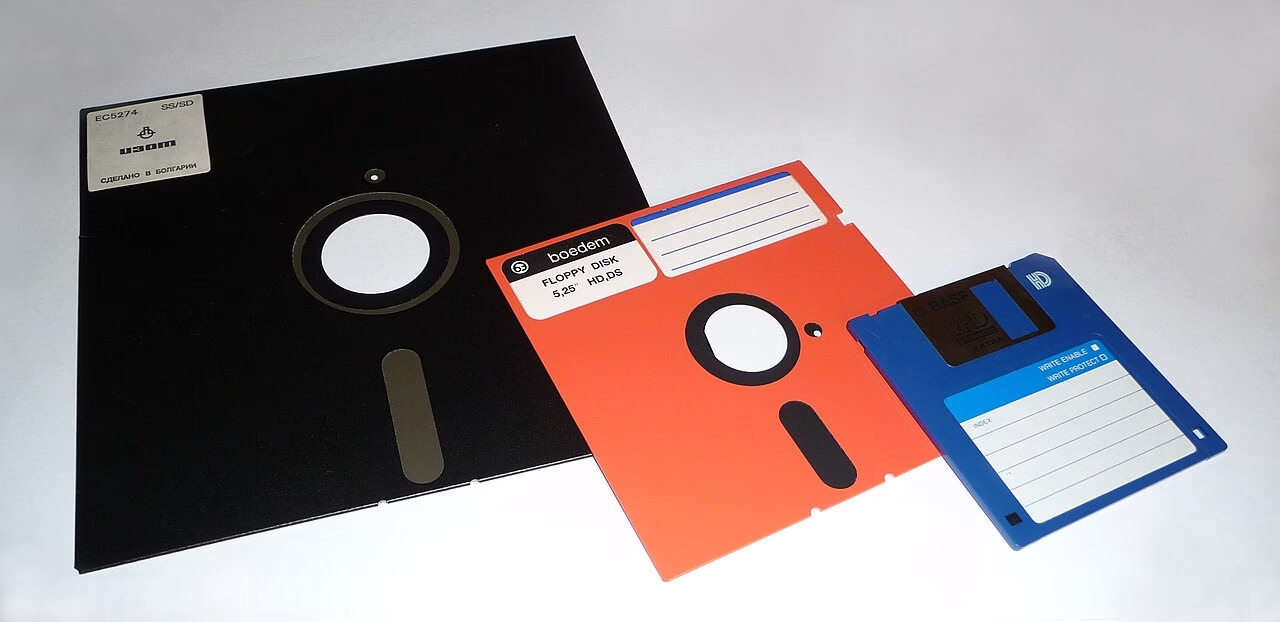
The floppy disk was a portable magnetic storage medium introduced by IBM in 1971. Initially, an 8-inch flexible disk encased in a cardboard jacket holding about 80 KB of data, it evolved into the rigid 5.25-inch version (up to 1.2 MB) in the late 1970s and the ubiquitous 3.5-inch hard-shell format (1.44 MB standard) by the mid-1980s, popularized by Apple’s Macintosh and Sony’s design. Data was written and read via a spinning disk coated with magnetic material, accessed through a sliding metal shutter, making it ideal for transferring files, distributing software, and booting systems. Image source: Wikimedia/George Chernilevsky

Read More »Technology 101: Floppy Disk Revolution: Why 1.44 MB Changed Everything

Economy 101: Rare Earth – Understanding the Robust Economy

Rare Earth Minerals Economy

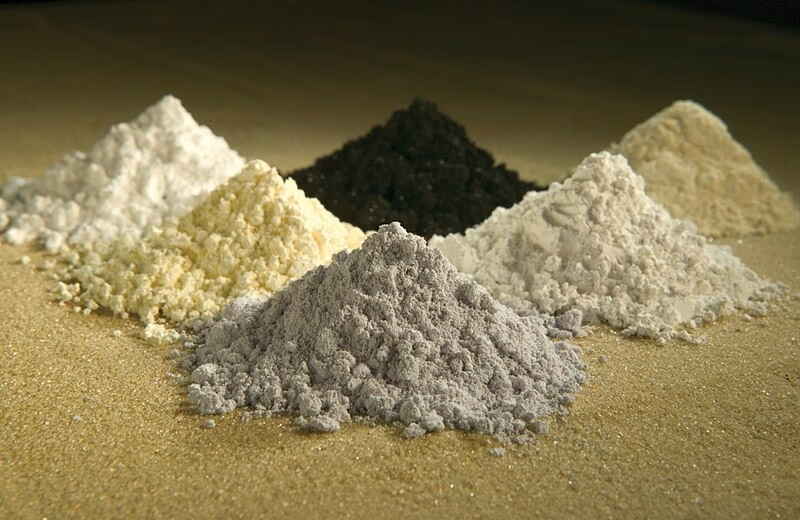
The following rare earth oxides, listed clockwise from the top center, are commonly used for tracking sediment movement and pinpointing erosion sources with high precision: praseodymium oxide (Pr₆O₁₁), cerium oxide (CeO₂), lanthanum oxide (La₂O₃), neodymium oxide (Nd₂O₃), samarium oxide (Sm₂O₃), and gadolinium oxide (Gd₂O₃). Each oxide is selected for its unique signature, enabling scientists to map sediment transport, assess erosion rates, and inform watershed management strategies to mitigate environmental degradation. Image source: Wikimedia/By Peggy Greb (US Department of Agriculture)

Read More »Economy 101: Rare Earth – Understanding the Robust Economy