Skip to content

Russia

Military 101: Bunker Buster Bombs: A Global Perspective

Bunker Buster Bomb Weapon US

The BLU-122 is a 5,000-pound class precision-guided penetrator warhead developed by the United States Air Force as a modern successor to the Vietnam-era BLU-82 “Daisy Cutter” and the earlier GBU-28 bunker buster bomb. It is specifically designed to defeat deeply buried and hardened targets (DBHTs) such as underground command centers, weapons-of-mass-destruction storage sites, and reinforced tunnels that are beyond the reach of the older GBU-28 (also 5,000 lb class) and even the 30,000 lb GBU-57 Massive Ordnance Penetrator (MOP) in certain scenarios requiring lower collateral damage or delivery from tactical aircraft. Image source: US Air Force / Wikipedia

Read More »Military 101: Bunker Buster Bombs: A Global Perspective

Military 101: The Evolution of Anti-Tank Weapons in World War II

Anti-Tank Bazooka Military Weapon World War 2

The Bazooka, officially known as the M1 rocket launcher, was a groundbreaking American anti-tank weapon introduced in 1942 during World War II, revolutionizing infantry warfare by providing foot soldiers with a portable means to combat armored vehicles. This shoulder-fired, 2.36-inch diameter tube launched fin-stabilized, high-explosive shaped-charge rockets (like the M6) up to 200 yards effectively, penetrating up to 100mm of armor—enough to cripple German Panzers and Japanese tanks. Image source: U.S. Army Signal Corps/Wikimedia

Read More »Military 101: The Evolution of Anti-Tank Weapons in World War II

Military 101: Modern Assault Rifles: A Global Perspective

M16 AK47 Assault Rifle Weapon Military

The M16 and AK-47 are iconic assault rifles with distinct characteristics: the M16, designed by Eugene Stoner and adopted by the U.S. military, is a lightweight, accurate, gas-operated rifle firing 5.56x45mm NATO rounds, offering a high rate of fire and effective range of around 600 meters, but it requires regular maintenance to avoid jamming in harsh conditions; in contrast, the AK-47, designed by Mikhail Kalashnikov for the Soviet Union, is a rugged, reliable, gas-operated rifle using 7.62x39mm rounds, with a shorter effective range of about 400 meters and less accuracy but superior durability and ease of use in adverse environments, making it a favorite in guerrilla warfare and among militaries worldwide. Image source: Wikipedia/Auge=mit – Own work, CC BY-SA 4.0

Read More »Military 101: Modern Assault Rifles: A Global Perspective

Technology 101: AWACS – Dynamics Of Electronic Jamming

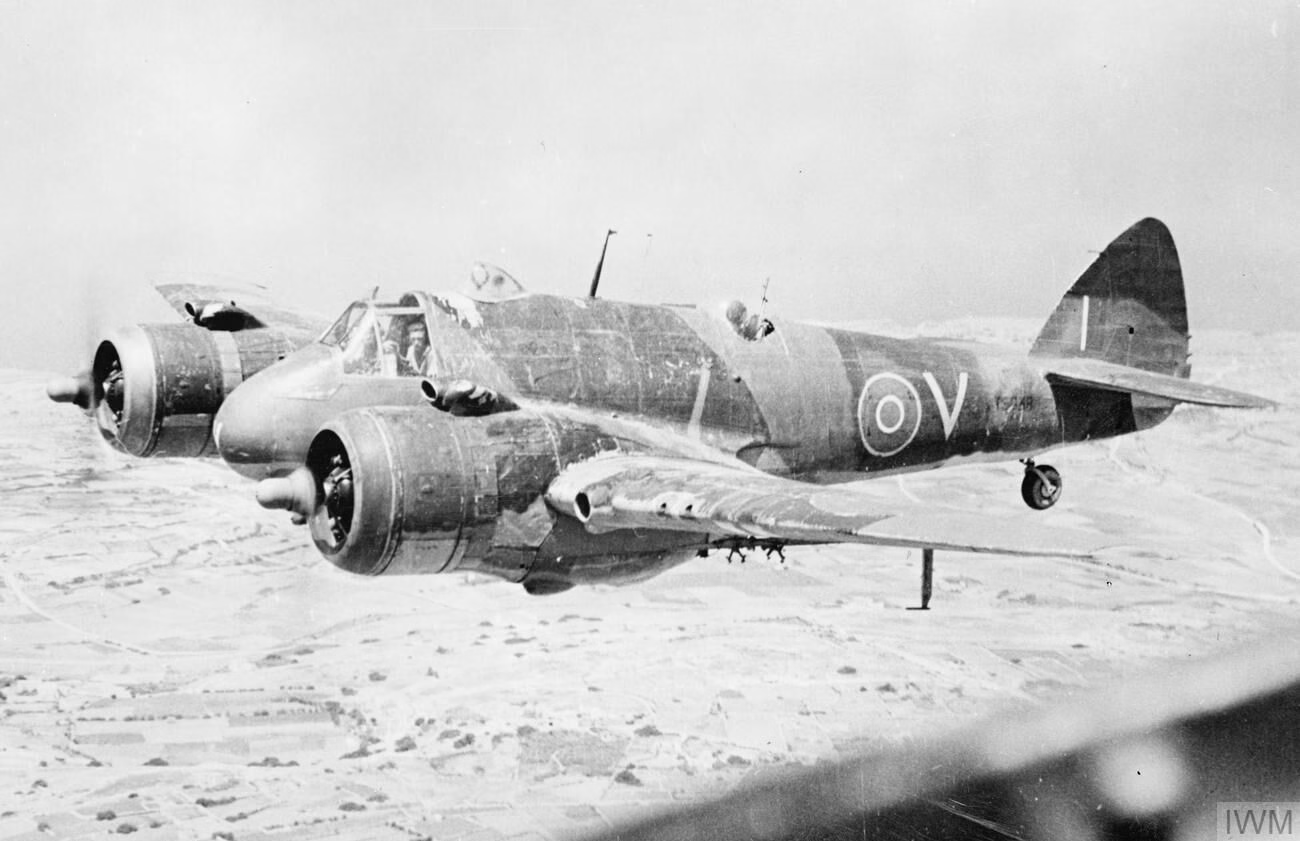
AWACS British Aircraft Plane Bristol Beaufighter Radar Early Warning

During World War II, dedicated AWACS aircraft did not exist, but several nations employed radar-equipped planes for detection. A notable example is the British Bristol Beaufighter, a twin-engine heavy fighter fitted with the Airborne Interception (AI) Mk IV radar. Serving the Royal Air Force (RAF) in night operations, it effectively tracked Luftwaffe bombers during the Blitz, with a radar detection range of about 10 miles. Lacking command-and-control capabilities, it relied on ground stations for coordination. Image source: Royal Air Force / Imperial War Museums

Read More »Technology 101: AWACS – Dynamics Of Electronic Jamming

Technology 101: Missions To Moon: A Giant Leap For Mankind

Lunar Moon Mission Astronaut Space

The Apollo program, a monumental achievement by NASA, was the United States’ endeavor to land humans on the Moon. Spanning from 1961 to 1972, it reached its pinnacle with Apollo 11 in July 1969, when Neil Armstrong and Buzz Aldrin became the first humans to walk on the lunar surface. In total, six Apollo missions successfully landed on the Moon, with 12 astronauts exploring its terrain and collecting valuable lunar samples. Image source: Unsplash

Read More »Technology 101: Missions To Moon: A Giant Leap For Mankind

World Mysteries 101: UVB-76 – The Ghostly, Strange Radio Station

Russia UVB-76 Radio Cold War Soviet Spy

UVB-76, often referred to as “The Buzzer,” is a notorious shortwave radio station that broadcasts a repetitive buzzing sound, which has been transmitting since the late 1970s. The signal, typically consisting of a short buzz tone repeating at a steady rate, is occasionally interrupted by voice messages in Russian. While the exact purpose of UVB-76 remains a subject of speculation, it is widely believed to be linked to the Russian military, serving as a means of communication or a method for testing the network’s readiness. Image source: Slavorum)

Read More »World Mysteries 101: UVB-76 – The Ghostly, Strange Radio Station