Skip to content

India

Military 101: Bunker Buster Bombs: A Global Perspective

Bunker Buster Bomb Weapon US

The BLU-122 is a 5,000-pound class precision-guided penetrator warhead developed by the United States Air Force as a modern successor to the Vietnam-era BLU-82 “Daisy Cutter” and the earlier GBU-28 bunker buster bomb. It is specifically designed to defeat deeply buried and hardened targets (DBHTs) such as underground command centers, weapons-of-mass-destruction storage sites, and reinforced tunnels that are beyond the reach of the older GBU-28 (also 5,000 lb class) and even the 30,000 lb GBU-57 Massive Ordnance Penetrator (MOP) in certain scenarios requiring lower collateral damage or delivery from tactical aircraft. Image source: US Air Force / Wikipedia

Read More »Military 101: Bunker Buster Bombs: A Global Perspective

Religion 101: Part 3 – Exploring the Trimurti: Shiva the Destroyer

Trimurthi Shiva Religion Hindu

The iconic 65-foot-tall statue of Lord Shiva at the Shivoham Shiva Temple (formerly known as the Shiv Mandir or Kempfort Shiva Temple) in Bengaluru stands as one of the city’s most awe-inspiring landmarks. Located on Old Airport Road in Murugeshpalya, this magnificent idol, consecrated in 1995 on Maha Shivaratri, depicts Him in a serene meditative lotus pose against a backdrop resembling Mount Kailash, with the sacred River Ganges cascading from his matted locks, his damaru (drum) and trishul (trident) in hand, symbolizing cosmic creation, preservation, and destruction. Image source: Wikipedia

Read More »Religion 101: Part 3 – Exploring the Trimurti: Shiva the Destroyer

Religion 101: Part 2 – Exploring the Trimurti: Vishnu the Powerful Preserver

Vishnu Krishnan Indian Hindu God Religion Trimurti Belief

Lord Vishnu, one of the principal deities in Hinduism, is revered as the preserver and protector of the universe within the Trimurti, alongside Brahma (the creator) and Shiva (the destroyer). Known for his benevolence, compassion, and role in maintaining cosmic order (dharma), He is often depicted with blue skin, holding a conch, discus, lotus, and mace, symbolizing his divine powers. He resides in Vaikuntha, the celestial abode, with his consort, Lakshmi, the goddess of wealth. Vishnu is renowned for his ten avatars (Dashavatara), including Rama, Krishna, and Buddha, through which he incarnates on Earth to restore balance and righteousness whenever evil prevails. Image source: Facebook

Read More »Religion 101: Part 2 – Exploring the Trimurti: Vishnu the Powerful Preserver

History 101: The Legacy of Legendary Chhatrapati Shivaji Maharaj

Chhatrapati Shivaji Maharaj India History

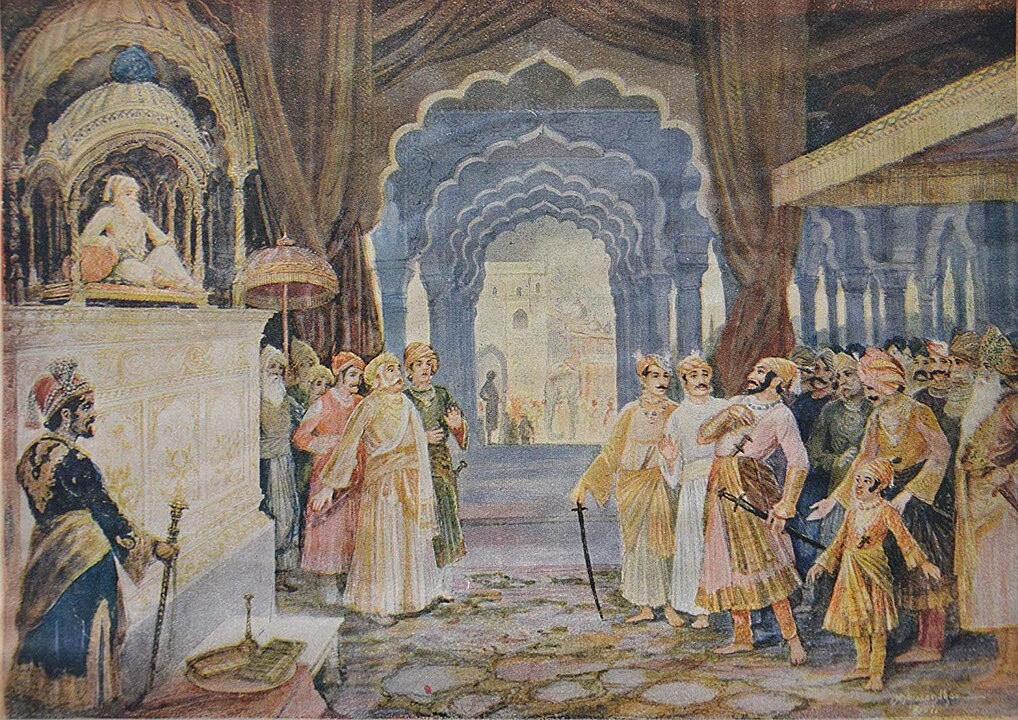
The painting portrays the dramatic meeting in 1666 when Chhatrapati Shivaji Maharaj, the founder of the Maratha Empire, was summoned to Aurangzeb’s court in Agra. According to historical accounts, this encounter was marked by tension, as Shivaji, a regional power, faced the mighty Mughal emperor at the height of his authority. Dhurandhar’s work captures this clash of personalities and ideologies, emphasizing Shivaji’s defiance and dignity in the face of Aurangzeb’s imposing presence. Image source: M. V. Dhurandhar/Wikipedia

Read More »History 101: The Legacy of Legendary Chhatrapati Shivaji Maharaj

Military 101: Modern Assault Rifles: A Global Perspective

M16 AK47 Assault Rifle Weapon Military

The M16 and AK-47 are iconic assault rifles with distinct characteristics: the M16, designed by Eugene Stoner and adopted by the U.S. military, is a lightweight, accurate, gas-operated rifle firing 5.56x45mm NATO rounds, offering a high rate of fire and effective range of around 600 meters, but it requires regular maintenance to avoid jamming in harsh conditions; in contrast, the AK-47, designed by Mikhail Kalashnikov for the Soviet Union, is a rugged, reliable, gas-operated rifle using 7.62x39mm rounds, with a shorter effective range of about 400 meters and less accuracy but superior durability and ease of use in adverse environments, making it a favorite in guerrilla warfare and among militaries worldwide. Image source: Wikipedia/Auge=mit – Own work, CC BY-SA 4.0

Read More »Military 101: Modern Assault Rifles: A Global Perspective

History 101: The Indus Valley Civilization: Ancient And Mysterious

Indus Valley Civilization Hindu India History

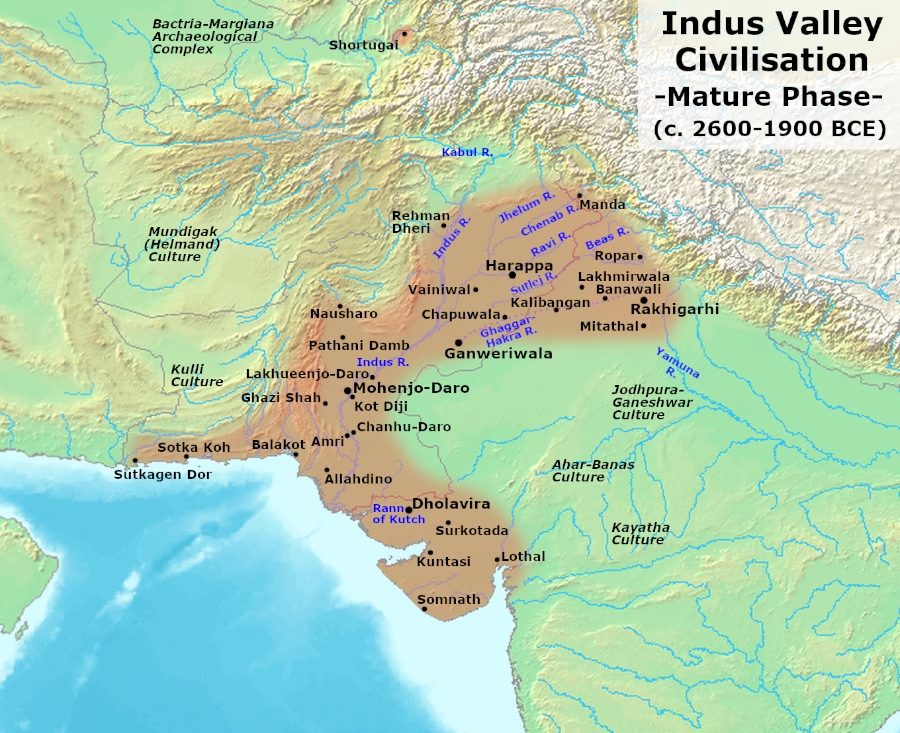
The Indus Valley Civilization (c. 3300–1300 BCE) was a Bronze Age civilization in northwest South Asia, centered along the Indus River in modern-day Pakistan and northwest India. One of the world’s earliest urban societies, alongside Mesopotamia and Egypt, it was known for major cities such as Harappa, Mohenjo-Daro, and Dholavira, among others, characterized by advanced urban planning, grid layouts, standardized brick construction, and sophisticated drainage systems. Image source: Avantiputra7 – Own work, CC BY-SA 3.0

Read More »History 101: The Indus Valley Civilization: Ancient And Mysterious

Technology 101: AWACS – Dynamics Of Electronic Jamming

AWACS British Aircraft Plane Bristol Beaufighter Radar Early Warning

During World War II, dedicated AWACS aircraft did not exist, but several nations employed radar-equipped planes for detection. A notable example is the British Bristol Beaufighter, a twin-engine heavy fighter fitted with the Airborne Interception (AI) Mk IV radar. Serving the Royal Air Force (RAF) in night operations, it effectively tracked Luftwaffe bombers during the Blitz, with a radar detection range of about 10 miles. Lacking command-and-control capabilities, it relied on ground stations for coordination. Image source: Royal Air Force / Imperial War Museums

Read More »Technology 101: AWACS – Dynamics Of Electronic Jamming

Health 101: The Goodness of Pulses – Indian Lentils and Legumes

Pulses Legume Lentils Indian Food Spices Cooking

Pulses, in essence, are the dried, edible seeds of leguminous plants, such as lentils, beans, chickpeas, and peas. They are nutritional powerhouses, packed with protein, fiber, vitamins, and minerals, making them a vital component of healthy and sustainable diets globally. Beyond their nutritional value, pulses play a crucial role in agriculture by fixing nitrogen in the soil, reducing the need for synthetic fertilizers and contributing to soil health. They are also generally affordable and have a long shelf life, making them an accessible and sustainable food source, particularly in developing countries. Photo by Agung Pandit Wiguna

Read More »Health 101: The Goodness of Pulses – Indian Lentils and Legumes